
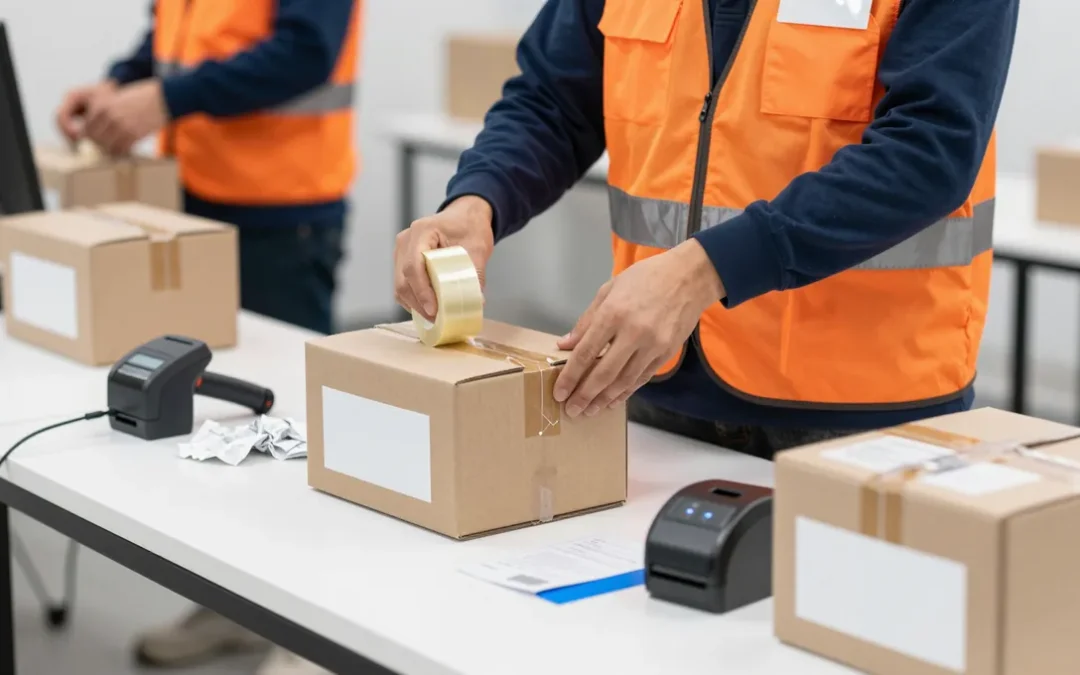
Every growing online brand reaches the same point: the spare room, garage or small unit is full, packing orders takes most of the day, and shipping mistakes start to creep in. That is when the question comes up: should you keep fulfillment in-house, or outsource it to a 3PL?
There is no single right answer. This guide compares in-house fulfillment and a third-party logistics (3PL) provider side by side, covers the real costs of each, and gives you a simple checklist to decide which fits your business today.
In-house fulfillment vs a 3PL at a glance
| In-house fulfillment | Outsourced to a 3PL | |
|---|---|---|
| Upfront cost | Space, racking, equipment, software | Usually a setup fee at most |
| Monthly cost | Fixed: rent, staff, utilities, whether orders are high or low | Variable: you pay for the storage and orders you use |
| Shipping rates | Your own carrier rates | Often lower, from the 3PL’s carrier volume |
| Scaling for peaks | Hire, rent and buy more yourself | The 3PL adds people and space |
| Control | Full, hands-on control | Shared, through reports, software and clear agreements |
| Your time | Spent packing, hiring and managing stock | Spent on sales, products and marketing |
| Best for | Very low volumes or very specialised products | Growing brands shipping steady volumes |
What in-house fulfillment really costs
Fulfilling orders yourself can look cheaper because there is no invoice from a 3PL. But the costs are still there, spread across your business:
- Space: rent or lease for storage and a packing area, usually on a multi-year lease.
- People: wages, training, cover for sick days and extra help at peak season.
- Equipment: racking, packing tables, scales, label printers, scanners and a pallet jack or forklift.
- Software: inventory and shipping tools to keep stock accurate.
- Packaging: bought in smaller quantities, so usually at a higher price per unit.
- Shipping: carrier rates for a small sender are often higher than a 3PL can get.
- Your own time: often the biggest hidden cost for founders and small teams.
What a 3PL costs
A 3PL charges for the services you use, normally receiving, storage, pick and pack, packaging and shipping. Costs move up and down with your volume, which makes them easier to plan around. For typical Canadian price ranges and a sample monthly estimate, see our guide: how much does a 3PL cost in Canada?
Pros and cons of keeping fulfillment in-house
Pros
- Full control over every order and how it is packed.
- Easy to add a personal touch, like handwritten notes.
- No need to send inventory to another location.
Cons
- Fixed costs that stay the same even in slow months.
- Hard to scale quickly for sales events or the holiday rush.
- Time spent packing is time not spent growing the business.
- Higher shipping and packaging costs at low volumes.
Pros and cons of outsourcing to a 3PL
Pros
- Pay for what you use instead of fixed overheads.
- Scale up for peaks without hiring or signing a bigger lease.
- Access to better carrier rates and experienced packing teams.
- Extra services under one roof: Amazon FBA prep, Walmart WFS prep, kitting, returns and B2B shipments to retailers.
Cons
- Less hands-on control, so communication and reporting matter.
- Some providers have monthly minimums or long contracts.
- Moving inventory to a new warehouse takes some planning.
Signs it is time to switch to a 3PL
- You or your team spend more than a few hours a day packing orders.
- You are running out of space, or about to sign a bigger lease.
- Orders ship late or with mistakes during busy periods.
- You want to sell on more channels, like Amazon, Walmart or wholesale.
- Shipping costs are eating into your margins.
- You are planning a big launch or seasonal peak.
If two or more of these sound familiar, it is worth getting a 3PL quote and comparing it with your true in-house cost.
When in-house fulfillment still makes sense
- You ship only a handful of orders a week.
- Products are made to order or need specialist handling a 3PL cannot offer.
- The unboxing experience is so personal that you want to pack every order yourself.
Many brands also use a hybrid setup: they keep custom or high-touch orders in-house and send their best-selling products to a 3PL.
How to compare the two: a quick checklist
- Add up your full monthly in-house cost: rent, wages, packaging, shipping, software and equipment.
- Divide it by your monthly orders to get your true cost per order.
- Ask two or three 3PLs for quotes based on your real order data.
- Compare cost per order, delivery speed, error rates and the services you would gain.
- Check the contract: minimums, notice period and how inventory is moved if you leave.
Our guide on how to choose a 3PL in Toronto lists the questions to ask each provider.
Outsourcing fulfillment in Mississauga and the GTA
Newsom 3PL handles warehousing, ecommerce fulfillment, cross-border shipping and GTA delivery from our Mississauga warehouse near Toronto Pearson. Every quote is built around the services you actually use. See how our quotes work, or contact us for a custom quote.
Frequently asked questions
Is a 3PL cheaper than in-house fulfillment?
Often, once you count rent, wages, equipment, packaging and the shipping rates a 3PL can access. At very low volumes, in-house can still be cheaper. Compare your true cost per order with a real quote.
How many orders do I need before using a 3PL?
There is no fixed number. Some 3PLs work with brands shipping a few hundred orders a month, while others set higher minimums. What matters most is whether fulfillment is taking time and space you need for growing the business.
Will I lose control of my inventory with a 3PL?
No. A good 3PL gives you visibility of stock levels and orders, and you still decide what is sold, how products are packed and where they go.
Can I use a 3PL for some products and ship others myself?
Yes. A hybrid setup is common: fast-selling products go to the 3PL while custom or made-to-order items are packed in-house.
How long does it take to switch to a 3PL?
It depends on how many products you have and how your store connects. Setup typically covers connecting your sales channels, agreeing packaging and sending your first inventory to the warehouse.