
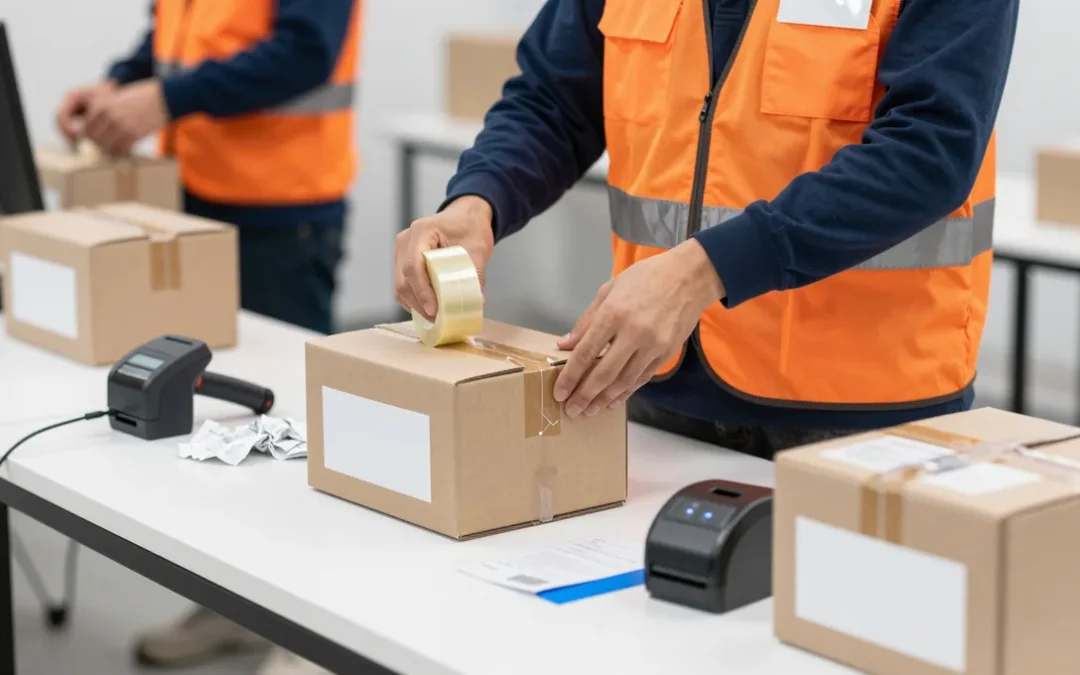
If you sell on Amazon.ca, the way you prepare inventory for Fulfillment by Amazon (FBA) changed this year. Since July 1, 2026, Amazon no longer offers its own prep and item labelling services for FBA shipments to Canadian fulfillment centres. Amazon made the same change in the United States on January 1, 2026. That means every unit you send to Amazon now has to arrive already labelled and packaged to Amazon’s standards, prepared either by you or by a 3PL prep centre.
This guide explains what changed, the core prep requirements Canadian sellers need to meet, and how to decide whether to prep in-house or outsource it.
What changed for Amazon.ca sellers on July 1, 2026
Before the change, sellers could choose to have Amazon apply item labels and complete some prep (such as poly bagging or bubble wrapping) for a per-unit fee. Amazon announced in April 2026 that this option would end for the Canadian marketplace. From July 1, 2026:
- Amazon is no longer an available option for prep or item labelling on new Amazon.ca inbound shipments.
- The change covers inventory sent directly to FBA as well as inventory that moves into FBA from Amazon’s other inbound programs.
- Shipments created before July 1, 2026 stayed under the old rules, according to seller reports.
- Sellers have reported that units arriving without the required prep may lose reimbursement protection if they are damaged or lost.
In short, prep is now the seller’s responsibility. Getting it wrong can mean delays at receiving, unfulfillable inventory or extra costs.
Core Amazon FBA prep requirements
Amazon publishes detailed prep rules by product type in Seller Central, and they are updated from time to time, so always check the current version for your products. These are the requirements that apply to most sellers:
1. Every unit needs a scannable barcode
Each unit must carry a barcode Amazon can scan. For most sellers this means an FNSKU label printed from Seller Central and applied over (or instead of) any other barcode on the packaging, so the scanner picks up the right one. Labels must be flat, readable and not wrapped around a corner or curved edge.
2. Poly bags must meet Amazon’s standards
Products that are loose, soft, dusty or could be damaged by dust, such as apparel and textiles, usually need to be poly bagged. Bags must be transparent so the barcode can be scanned through them, fully sealed, and bags with an opening of 5 inches (12.7 cm) or more must carry a suffocation warning.
3. Fragile items need protection
Glass, ceramics and other breakable products should be bubble wrapped or boxed so they can survive a drop. Items with sharp edges must be covered so they cannot injure handlers or damage other inventory.
4. Sets and bundles must be clearly marked
If several items are sold together as one unit, they must be packaged together and marked so they are not separated at the fulfillment centre, for example with a “Sold as set, do not separate” label, and only the set’s barcode should be scannable.
5. Expiration-dated products need visible dates
Food, supplements, cosmetics and other expiration-dated products need the expiration date clearly shown on each unit and on the outside of the box, in the format Amazon requires.
6. Boxes must meet Amazon’s carton rules
Shipping boxes need to stay within Amazon’s maximum size and weight limits for your marketplace, carry the correct shipment and box labels from your shipping plan, and be packed so contents do not shift. Check the current box limits in Seller Central before you pack, as oversized or overweight boxes can be refused or incur fees.
Prep in-house or use a 3PL prep centre?
With Amazon’s service gone, Canadian sellers have two options:
- Prep in-house: you or your team label, bag and box every unit. This can work at low volumes, but it takes time, space and supplies, and mistakes are costly.
- Use a 3PL prep centre: your supplier ships inventory to the prep centre, which receives, inspects, labels, packages and sends it to Amazon. This is often more practical as volumes grow, especially if you import from overseas.
A local prep centre also lets you hold bulk stock outside Amazon and send smaller replenishment shipments as you sell, which helps you stay within Amazon’s inventory limits and avoid stockouts.
A simple FBA prep checklist
- Check the prep requirements for each product in Seller Central.
- Create your shipping plan and print FNSKU, box and shipment labels.
- Inspect units for damage and count them against your purchase order.
- Label every unit, covering any conflicting barcodes.
- Poly bag, bubble wrap or box products that need it.
- Mark sets and expiration dates where required.
- Pack boxes within Amazon’s size and weight limits and apply box labels.
- Ship to the fulfillment centres in your plan and track receiving.
How Newsom 3PL can help
Newsom 3PL provides Amazon FBA prep and replenishment from our warehouse in Mississauga, close to Amazon’s Ontario fulfillment centres. We receive your inventory, apply FNSKU labels, handle poly bagging, bubble wrap and bundling, label your cartons and pallets, and ship to Amazon. We can also store your bulk stock and send replenishment shipments as you need them, and prep for Walmart WFS from the same inventory.
Request a quote and tell us about your products and volumes.
Frequently asked questions
Does Amazon still label or prep FBA items in Canada?
No. Since July 1, 2026, Amazon no longer offers prep or item labelling services for FBA shipments to Canadian fulfillment centres. Sellers must prep units themselves or use a third-party prep centre.
When did Amazon stop FBA prep services in the US?
Amazon ended its FBA prep and item labelling services in the United States on January 1, 2026.
Do all products need poly bags?
No. Poly bagging is required for certain product types, such as apparel, textiles and items that could be damaged by dust. Check the prep guidance for each product in Seller Central.
What is an FNSKU label?
An FNSKU is Amazon’s fulfillment network SKU. The FNSKU label identifies your unit as your inventory in Amazon’s warehouses, so Amazon can track it back to your seller account.